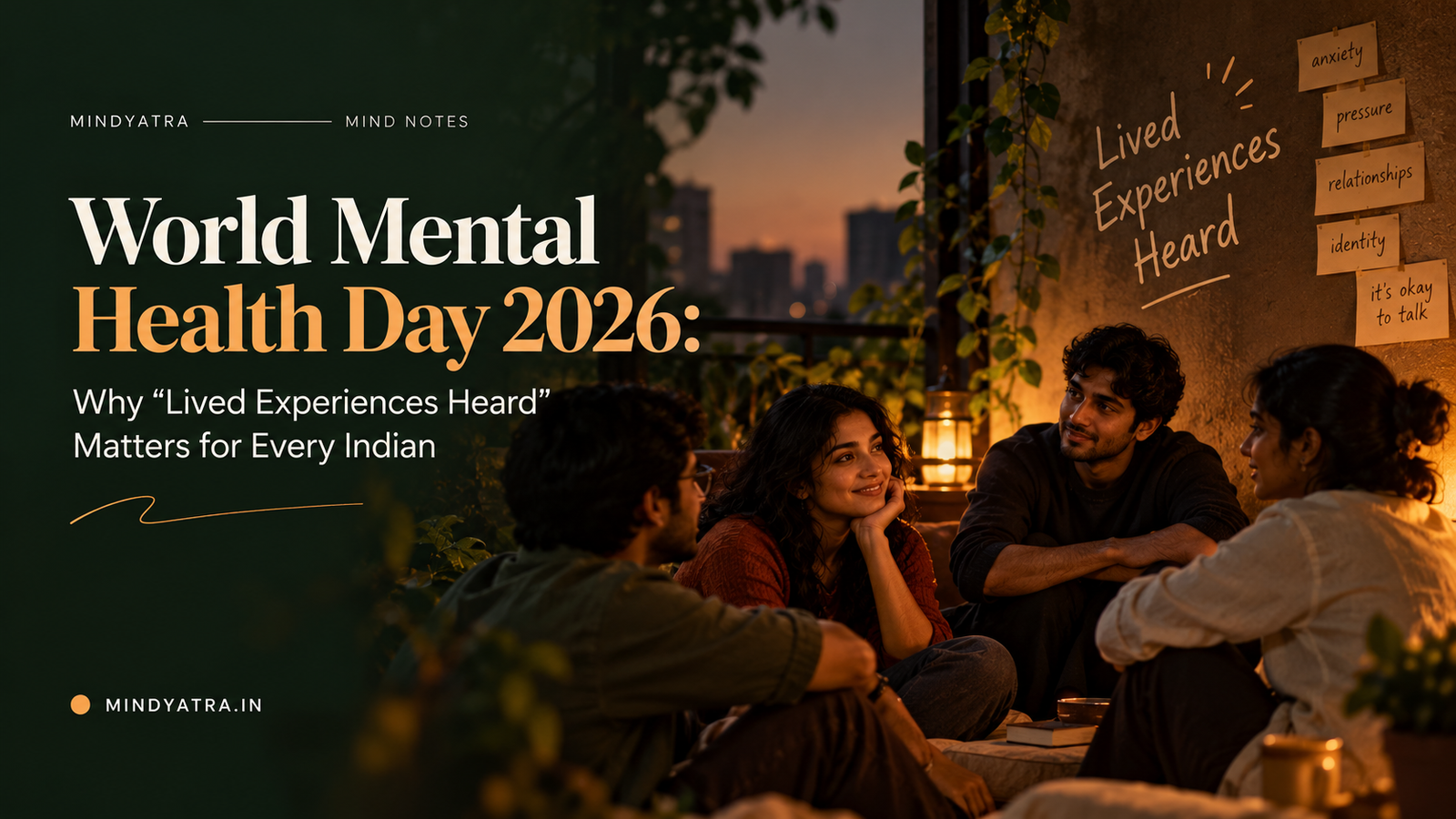
World Mental Health Day 2026: Why "Lived Experiences Heard" Matters for Every Indian
Every year on 10 October, the world pauses to talk about mental health. Social feeds fill up with green ribbons and quotes, offices plan a session or two, and for a day, the topic feels a little less awkward to bring up.
This year's theme asks for something deeper than a post. The World Federation for Mental Health, which started World Mental Health Day, has chosen "Lived Experiences Heard: Real Voices, Real Change" as the theme for 2026.
In simple words: listen to the people who have actually lived through it.
What does "Lived Experiences Heard" mean?
A lived experience is exactly what it sounds like. It's what someone has been through, in their own life, in their own words. Not a textbook definition of anxiety, but what it felt like for your colleague to sit in a meeting with her heart racing. Not statistics on burnout, but your friend telling you he hasn't felt like himself in months.
The theme is a reminder that real change in mental health doesn't only come from experts and policies. It also comes from ordinary people feeling safe enough to say, "This is what happened to me," and from the people around them being willing to listen.
When stories are heard, a few powerful things happen. People realise they're not the only ones. Shame starts to loosen. And those who are struggling quietly begin to believe that asking for support is allowed.
Why this theme matters so much in India
In many Indian homes, feelings are handled quietly. We ask each other "khana khaya?" far more often than "how are you, really?" A tough week becomes "just stress." Exhaustion becomes "you need to sleep early." And a lot of us grow up hearing some version of "what will people say?"
None of this comes from a bad place. Families want to protect us. But it often means people carry things alone for a very long time.
You can see it everywhere if you look closely:
- The student who smiles through results week and cries in the bathroom
- The young professional who answers every work call but hasn't told anyone they can't sleep
- The mother who takes care of everyone's needs and quietly feels she has nothing left for herself
- The friend who always says "all good, yaar" because it's easier than explaining
These are lived experiences too. They don't always look dramatic. Most of the time they look completely normal from the outside. That's exactly why they need to be heard.
The good news is that things are slowly changing. More people are talking openly online, more workplaces and colleges are making space for these conversations, and more of us are realising that looking after your mind is as normal as looking after your body.
6 simple ways to mark World Mental Health Day this year
You don't need an event or a big announcement. These small things fit the theme perfectly.
1. Ask someone twice. When a friend says "I'm fine," try a gentle follow-up: "No, really, how have you been?" Sometimes the real answer only comes out the second time.
2. Listen without fixing. If someone opens up, you don't have to solve anything. Just listen. Being heard is often the help they need most.
3. Share a little of your own story, if you feel ready. It doesn't have to be public or detailed. Telling one trusted person how you've really been doing can make it easier for them to open up too.
4. Check in with yourself. Take five quiet minutes and ask: How am I actually feeling these days? What's been weighing on me? Write it down if that helps.
5. Start a conversation at work or college. A short chat over tea, a team check-in, or a small session can make a big difference. It shows people that the topic is welcome.
6. Save a helpline number. Keep Tele-MANAS, 14416 (free, 24x7), in your phone. You may never need it, but someone you know might.
Your story deserves to be heard too
The theme talks about real voices, and that includes yours. Maybe you're not in a crisis. Maybe you're just tired in a way sleep doesn't fix, or you've been overthinking more than usual, or you feel a bit far from your usual self. That's still worth paying attention to.
At MindYatra, we start by listening. We first understand where you are, and then help you find the support that fits.
- Know Your Mental Health assessment: share a little about yourself, express what you're feeling through words, a drawing or a voice note, and get an expert-reviewed report within 24 hours.
- REVIVE: a guided 5-day process with a psychologist that maps your emotional patterns, stress triggers, behaviour loops and blind spots.
- Counselling and psychotherapy: one-on-one support for when you need someone with you for longer.
This World Mental Health Day, let your own experience be heard, even if the first person you tell is yourself.
Start your Know Your Mental Health assessment
Want to talk to us first? Message us on WhatsApp at 9538186224 or email mindyatra.help@gmail.com.
Frequently asked questions
When is World Mental Health Day 2026? World Mental Health Day is observed every year on 10 October. In 2026, it falls on a Saturday.
What is the theme of World Mental Health Day 2026? The theme is "Lived Experiences Heard: Real Voices, Real Change," announced by the World Federation for Mental Health. It focuses on listening to people who have lived through mental health challenges and letting their voices shape change.
Who started World Mental Health Day? It was started by the World Federation for Mental Health and was first observed in 1992. Today it's supported by organisations around the world, including the World Health Organization.
How can students and colleges observe World Mental Health Day? Colleges can host open conversations, invite a counsellor for a talk, share helpline details, or simply create a space where students can talk without judgement. Students can check in on friends and on themselves.
How can workplaces observe World Mental Health Day? A short team check-in, a session with a mental health professional, or a reminder of the support available to employees all help. Most importantly, leaders can make it clear that talking about mental health is welcome.
Do I need to be struggling a lot to seek support? Not at all. You don't need to be in crisis to look after your mind. If you've been feeling tired, overwhelmed, or simply not like yourself, that's reason enough to start.